Thursday, March 11, 2021

Builders and Modelers

https://image.freepik.com/free-photo/construction-worker-building-site_93675-20912.jpg
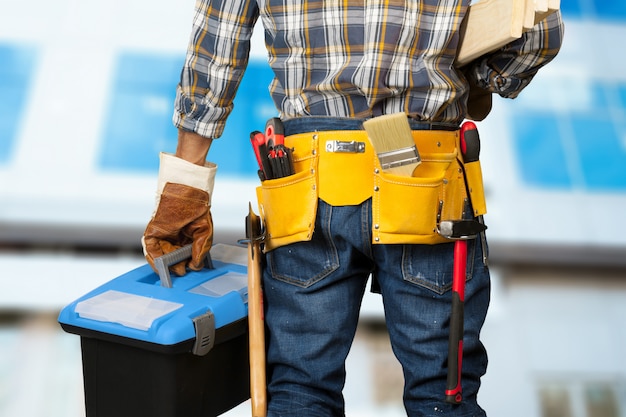
Are you a Builder or a Modeler?  Image Source

This is another one of those Facebook notes I've forgotten having written, because FB dropped its Notes section, but came up in my FB notifications after someone liked a comment wherein this article came about.

-----------

This was inspired from a response to a comment from Raeon Co, a fellow Gunpla hobbyist, in one of the discussions we have somewhere in the nether regions of cyberspace, about the difference between a builder and a modeler.

As per the definitions from Collins Dictionary:

  • Builder, noun. Plural form, builders.
    -A builder is a person whose job is to build or repair houses and other buildings.
  • Modeler, noun. Plural form, modelers. Spelling form, modellers.
    -A modeler is someone who makes shapes or figures out of substances such as wood or clay.
    -A modeler is someone who makes theoretical descriptions of systems or processes in order to understand them and be able to predict how they will develop.

Now, as you can see, neither of the definitions indicate anything about our favorite hobby, but let’s appropriate both since they are applicable in context.

Both can be used as blanket terms when describing what we do when we mangle and dunk Gunpla in paint, but, what's wrong is to trying to distinguish what the other does in deference to the other, or making one term look superior to the other. That's why sometimes, I include both terms, modelers/builders in the same sentence/paragraph when I comment.

Technically (and I mean technically), we are all builders, regardless if we build the simplest SDs, or the most complex PGs, or build things from scratch whether in part or in full.

Technically, on the other hand we're also all modelers, because we build scale models*. Now some of the <elite> in scale modeling scoff at Gunpla builders just because, but that's besides the point.

What we're really talking about here is skill levels; there's beginner, novice, intermediate, and expert. But, here's what's going to bake your noodle: We are all beginner's just ONCE.

Why is that, you ask?

Once you buy your first kit, and build it, you build it as a beginner. Gunpla is a simple enough thing to build, with pictogram, and now even English instructions. So, that shouldn’t be too much of a stretch now, would it? Yet, we can see those who have built things before asking about issues they have to watch out for about a new kit they want to purchase as if knowing those issues will change anything, like, maybe it’s more difficult to build. Whereas it’s a valid concern when you’re a beginner, it’s rather a silly one if you’re on your 10th kit.

All kits, regardless of grade or scale, are basic builds, with basic instructions. They all have the same level of difficulty. What varies among kit scales and grades is the complexity of the build: the higher the grade, the more complex the build.

Anyway, after that first kit is built, you are no longer a beginner, but a novice, or a newbie, to disambiguate from NOOB, which is coined by expert gamers as an insult to novice ones who suck, mainly because they are newbies (though I believe, newbie was also an insult back then, but wasn’t insulting enough that a new word has to be coined. Now certain people are starting to adapt the term noob to describe themselves out of ignorance).

You will stay a novice on your second, third, hundredth snapbuilt kit, if you don't do anything else but snapbuild, but, sure, you can call yourself an expert snapbuilder for snapbuilding hundreds of kits, nubmarks and all.

Now, if at your second to hundredth kit, you started minding the nubmarks, panel lining and/or topcoating, doing minor mods and fixes, do minor kitbashes, to make your objet d’art a little more interesting for you, if not for others, then you're in the intermediate level. Some people start to paint at this level as well, but nothing too fancy or extravagant.

The expert level is tricky to know if you have achieved it, because you probably already are, but not know it, or think you are, but others don't think it, maybe because those others are better-skilled than you are and can see you have a long way to go, or, on the other hand, you have gained enemies that think your skills are worth squat. Truth of the matter is, the expert level becomes very flexible and arbitrary: as you become an expert at modifications, fixing, painting, kit-bashing, and finally, scratchbuilding, in varying degrees, you find yourself needing, because there are others who are better at it.

If you are a true, mature, emotionally-balanced builder/modeler you’ll realize that there are certain things you can do, and cannot do. You can fix, modify, or build some things but not others, hence your expertise is varied but/or still evolving. If you can do something other experts can do (or more), you're an expert.

But, if someone calls you master (as I have been numerous times), or tags you as an expert, you need to have an honest discussion with your ego not to let it go to your head, which is where praises usually go straight away.

Those are different skill sets as well. One can be an expert of one or two skills, but not another. One can do a great paint job, regardless of medium, but, suck at modifications, like scribing or extensions, articulation mods, and vice versa.

So, it's all about the skills. We're all builders and modelers. We are builders because we build scale models (of giant robots), whether it’s a simple snap-build to a hefty scratch-build.

*We are modelers because we style those models to our liking, regardless
if we simply determine and tinker a kit’s poseability for the most dynamic, back-breaking and crotch-splitting pose, or when we sculpt kits in part or as a whole.

Truth of the matter is, even experts who are honest with themselves at what they can or cannot do at their levels still continue to learn, especially basic skills that elude them.

Like nub removal.

So, what made you think you're an expert? A million likes, perhaps?

The Million Likes Syndrome

(Previously titled "A Long Rant about Plastics and Modeling")

This rant was actually brought on after “reconnecting” with
Kenny Lim when I read one of his posts on FB. Kenny is one of the Master Modelers I know, having met him personally when he and the Poison Monkeys visited the Philippines a few years back, since I started doing nasty stuff to Gunpla. I regard Kenny as one of my “teachers,” having followed his builds over the years. His post was about something else entirely, but, still rather connected since it was also about Gunpla, and “modelers” as it were. Kenny is a VERY NICE GUY. Compared to my acerbic (ascorbic, acidic) personality, he’s a kitten. But, as we all know, even kittens have claws. It’s very rare for him to post reactively, and when he does, you can be sure it’s warranted. He and I had a short chat yesterday, and this long entry, something I have been putting off, is the result of that.

As I continue to labor over my musings over the things that need to be done in the projects I'm currently working on, I set aside a few minutes to ponder the nature and realities of what has been my go-to activity to de-stress myself from real-life work and concerns, whether I have the time for it or otherwise. I've been at it for several years now; tinkering with plastics, building and destroying and building again, inhaling plastic dust and paint fumes.

It was on and off, years earlier, "collecting" and snap building, and giving up when small versions of me mistook my 1/144 Wing series Gunpla for dolls and toy soldiers. I’ve actually never considered getting into it again; I like watching anime, but, collecting was never really my thing. I’ve had trading cards and comics before, and once I’ve lost interest, it seldom does recur.

But, I've restarted collecting Gunpla in 2007, I believe, when I got a regular gig that paid quite nicely (not my desired salary, but, close), and I was making enough and then some (I still have freelance gigs) to afford getting the real stuff (I was already aware of bootlegs circulating, having made trips to the magical place called Divisoria where everything is relatively cheap[er], but, even then, I was a stickler for quality). But, what really sparked my come back was after watching the Gundam 00 series, given to me by one of my co-designers at work.

I ignored the darned thing for several months, but when I did start watching it, the Exia gave me that chill I thought I lost after my 1/144 Wing Fab Five got swept away in a major flood, back when I was still a merman in the outskirts of Malabon. A week later, I found myself browsing the kits at GreatToysOnline, back then when they had a branch at Goldcrest, which is now the New Glorietta at Makati. I saw the NG 1/100 Exia and I was immediately enamored with it. I built it just under 2 hours as soon as I got home and got enough food in me, using nothing but an old basic Tamiya side-cutter which I have had since my 4WD racing days.

The kit was simple enough, hence why I built it quite quickly, not minding the nubs, seams and other taboos which plague everyone in the Gunplaverse. The week later, even with the next payday a few days away, I bought the Dynames. The week after that, the Kyrios. It took me a couple or so weeks before I realized I'm hooked, and bought the Virtue. My first MG as it were, was the Zeta Plus A1, followed by the Wing verKa. As soon as it was out, I got the NG 00, which was disappointing, to say at least, compared to its predecessor the Exia.

Then, I quit that job (which gave me nice abs and lean figure since I had to walk a couple of kilometers or so everyday) and went back to freelancing, and with no steady income stream, I had to hold back on purchasing any new kits, since honestly, it's quite impractical (and why some people say they buy bootlegs). I NEVER found bootlegs as practical; to me, it's nothing but a waste of my hard-earned money, to which, was exacerbated since I was not getting regular projects at the time.

Until now, I'm still basically doing freelance work, and, my teaching and resource-speaking gigs, as well as some photography work allows me some leeway to get the kits I want (even MBs and PGs). I’m not so much into gadgets, I recently got an iPhone to replace my 10 year old SE W810i, only because I needed it for actual work, so I can basically divert funds as needed. Nowadays, when I get a kit, I don't build them right away, except if it were something rather impressive-looking, like the Nu and Sazabi verKa. It takes me longer to build them now, sometimes even days at a time, since I can only devote a few hours of tinkering with a new kit, regardless of complexity.

When I got the PG Unicorn, which is, I can say, a MONSTER build, I really thought I would be able to finish it in a couple of days. I was able to build the head, torso and waist in 2 days, but have stopped there. That was a year ago. So, what's wrong, you ask? It's something I ask myself, only to realize that there's really nothing wrong at all. My "passion" comes in stages and waves, similar to how it is when I write songs. There are times, when I can write a song in a day, and times when years have gone, and the song still hasn't so much of any lyrics, that I hum gibberish just to remember the melody. The PG Unicorn will be finished, and will become the PG Chimera 2.0.

(Update-01 September 2017: I’ve finished the PG Unicorn a few months ago, and it’s missing its left front side skirt. I’ve stopped looking for since then. I’m planning to just scratch-build a custom pair of skirts for it).

As of the moment, the Hellraiser takes precedence, and after that, the Goliath. But, this is really nothing more but a long prelude to what I really want to say, especially to you new people in the hobby. Whereas I'll say it's just a hobby, something we pass time with, the skills we develop (or in my case, discover) is nothing to sneeze at. But, that is if we use those skills to GROW. If we keep doing the same things over and over, without any variations, without experimentation, our skills will stagnate. Whether it's snap-building and de-nubbing (the two BASIC skillsets), painting, modifying or scratch-building, (the two BASIC skillsets), painting, modifying or scratch-building, the learning NEVER stops. Just because something you've built earned you several thousand <likes> doesn't mean you've actually built a masterpiece.

Nowadays, posting a horrendously-painted and and nub-infested™©® snap-build can earn as many likes as your masterpiece, so using those likes as a reference for achievement is really nothing to be proud of. In fact, a lot of new "builders" don't even know how to denub and sand properly, and panic too much when a part breaks or worse gets lost in the wilderness. Building and modeling has stages. I understand that most people just want to snap-build and display kits, but, again, snap-building is a BASIC skill, everyone knows how to do it (or in some case, should know how to do it), and is not so much an accomplishment to be proud of. I’ve seen a lot of people even include their girlfriends (?) or girls in their posts to earn likes, but ultimately, snap-build can earn as many likes as your masterpiece, so using those likes as a reference for achievement is really nothing to be proud of.

In fact, a lot of new "builders" don't even know how to denub and sand properly, and panic too much when a part breaks or worse gets lost in the wilderness. Building and modeling has stages. I understand that most people just want to snap-build and display kits, but, again, snap-building is a BASIC skill, everyone knows how to do it (or in some case, should know how to do it), and is not so much an accomplishment to be proud of. I’ve seen a lot of people even include their girlfriends (?) or girls in their posts to earn likes, but ultimately,
no one learns anything by getting a million likes.

Moreso, one is only as good as one’s “pièce de résistance.” Expounding on that, one can really only have ONE masterpiece, with a new one overthrowing the previous, or not at all, as the case may be.

Pride. That's something I've been working on to take out of my vocabulary. I've successfully stopped using <hate> in that context, mentioning it simply as a word I have to mention as an emotion I no longer have, replacing it with dislike, or unlikable, but pride is something else. Whereas people post stuff online to show, to get reactions, to get attention, I've actually been posting my work mostly to teach. There's still a little bit of "pride" in that effort, but, it's not the same pride as, say, being proud that PacMan is a Pinoy boxer. It’s more like, being able to do the things no one else can, or no one else will, and when other people start doing the same thing, I just do something else that hasn’t been done before.

Incidentally, when I started doing modifications, it was because of an Exia. , but pride is something else. Whereas people post stuff online to show, to get reactions, to get attention, I've actually been posting my work mostly to teach. There's still a little bit of "pride" in that effort, but, it's not the same pride as, say, being proud that PacMan is a Pinoy boxer. It’s more like, being able to do the things no one else can, or no one else will, and when other people start doing the same thing, I just do something else that hasn’t been done before.

Incidentally, when I started doing modifications, it was because of an Exia. Erix93, one of the very few I consider a master modeler, inspired me to do modifications when I saw his modified NG Exia. I was already "painting" back then, which was more fumbling with Bosny spray cans (something I picked up from (something I picked up from DC23/Don Suratos), but didn't dare cut my precious kits with anything else but a side cutter. Looking at Erix93's WIP, something in my head lit up and screamed "I can do that shit too!"

As such, I realized that my years of destroying stuff when I was a kid, dissecting them to see how they work, were all leading to building stuff later on (else, why would have I taken Engineering, right?). My very first attempt was a custom, using the NG 00 as a base. I planned to do something radical, something entirely different, a Gundam like nothing else. I bought tools, putty, masking tape, pla-plates and a few other things I thought I would need, and thus began my adventure in mangling plastic.

And mangle it I did. It was a failure. I can't seem to get the putty to work for me the way I want it to (and I’ve tested several), so I abandoned the project altogether, and left the 00 parts in limbo. That failure didn't deter me, though. I took it as something to learn from, what to do and not do in terms of knowing what plastic is in general. It might sound like overthinking, and it is, but, whereas Erix93 used putty and was good at it, I found the material's incompatibility with plastic an issue I don't want to deal with. I know I can use putty well enough, but, it being messy and incompatible was a prospect not worth pursuing.

So, I decided to do mods with my favorite go-to material: Polystyrene Sheets (or, for those unfamiliar, Tamiya Pla-plates, and in my case, WHIPS). It was an almost unimaginable concept. At that time (or probably even now), I haven't seen anyone using PS sheets exclusively, even on curved/spherical parts, so, it might be something I can exploit. With PS sheets and cement, I was able to build parts that normally can only be built with putty. Forming PS sheets is not a picnic, and is a very resistant material without heat. But, I was determined to push it to its limit and literally, bend it to my will.

And so I have. I've bent PS sheets and formed it to something else, something I didn't realize myself could be done until I was actually doing it. But, it can only bend so much, and without heat, can only curve so much. So, what do I do now? Much like how putty is formed over parts, then sand-sculpted, PS sheets can be cemented, or "sandwiched" together and sculpted into a fine piece of p-art (pun-intended), to the point that it actually looks it was molded or cast. PS Sheets were like “putty in my hands,” as one of my followers dropped in a comment (or was it someone else who mentioned it in a long gone chat session).

The versatility of PS sheets is a such, it can be heat-formed as well, but, I haven't gotten to that point yet. Maybe with the Goliath (which is a 1/60 Strike Freedom Conversion to a 1/144 Destroy Gundam for Gary Berba).

Now, having said all this, what does it have to do with you? Well, I have a few things for you to consider:

1) Do research, and learn how to do research. Facebook groups do have helpful members, but use the internet to its full potential. Look for builds other than Gunpla, like scale modeling, or even documentaries on industrial processes. Facebook is NOT the only source of information. Veteran modelers do veteran builds because they learn not just from a single source, but multiple sources of varied genres. Also, as I do this quite frequently when the query warrants it, “google it” is a valid answer.

2) Before asking questions, READ the entire entry. NO matter how long it is. If something is unclear to you, ask COMPLETE, SPECIFIC, CONCISE and ARTICULATED questions. Asking “how did you do that?” is rather an open-ended question, and if the source was a tutorial, the answer is most likely IN the tutorial. People nowadays tend to lean towards spoonfeeding, that they no longer bother to read, let alone, let alone comprehend what’s already been said or shown.

3) Learn from the Good and the Bad. I’m talking generally about good builds and bad ones, good people and bad people, hecklers and trolls, Master Modelers and (ugh) Wannabes (those, of whom I mentioned earlier, who are more after likes than actual learning, I’m sure you’re not one of those, but, who knows? Denial is not a river). Find what is useful and ponder on what is not; you might be able to turn it around and make it useful.

4) Learn to LOOK rather than just see. This is sometimes because of detail blindness, which everyone experience from time to time (even myself), but, there are times when people just don’t bother LOOKING deeper into what they see (this is the visual equivalent of comprehension).

5) “Gunpla is freedom” does not mean what you think it means.

6) Snapbuilding is not a skill to be proud of. It’s a BASIC skill. So is removing nub marks (and NOT numb marks, which seem to be a common mistake by Filipinos).

7) A topcoated kit IS NOT a “painted” kit. In fact, I personally avoid topcoating altogether since modern kits especially do not need extra protection. They have one built-in. That shiny surface gloss isn’t there just for show, it’s actually a surface coating that protects plastic. So as long as you keep your kits away from direct sunlight, heat, and extreme humidity, it will be fine. Also, certain topcoats may turn your kits yellow, or worse, make it brittle over time.

8) A kit-bash IS NOT the same as a scratch-build. Kit-bashing is a type of modification. Scratch-building (as the term implies) is something else altogether. Whereas kit-bashing uses the parts as is (with minor modifications), scratch-building can also be using an existing part for its connectivity, and building OVER it to create something new or different.

9) “I can’t do that,” “I don’t have that skill,” “I’m just a snap builder” is something you should acknowledge, but NEVER use as a defense.

10) “Spray can paints are too thick.” If you’ve done enough research, you’ll find out that some spray-can-painted kits have been mistaken for airbrushed ones (and vise-versa). Knowing how to use a tool is more important than having a better tool.

11) “I need expensive tools.” Yes, and no. Learn which tools have alternatives (do research). There are tools that can do what its expensive counterpart can, and sometimes, even better, without having the hefty price tag, but even more durable to boot. Having a godhand cutter doesn’t give you a “god hand.”

12) Learn from the Wisdom of those before you. Give credit where credit is due.

13) Failure is nature’s way of telling you to try again. If it fails again, try something else.

14) Experiment. Sometimes, testing materials or techniques yourself is quicker and more beneficial than asking what works. You’ll learn something in the process as well as maybe discovering a new technique in the process.

Update 18 May 2020: This article is now translated into Spanish, courtesy of Emmanuelle Acevedo of of Gundam & Models Columbia - Fanpage. Seems like my words have gone international and tri-lingual.

Update 11 March 2021: Reformatted for the MXGS blog.

Thursday, March 4, 2021

Tricky Terminologies in Branding

I’ll state this as plainly as I can. This article does not talk about choice, nor aim to curtail your right to buy products made from stolen intellectual property. It’s about Gunpla, its branding, and why bootlegs are not 3rd party Gunpla.

The Bandai vs bootlegs debacle has been going on ever since the first bootleg came out, I have a few posts here regarding it, and has continued to drag on with the emergence of social media. The issue won’t die because every year there are new people getting into the hobby, poisoned by friends, co-workers, enemies or family, or at least every time there’s a new Gundam series being aired. There will always be a kit line that follows (or even precedes) it, and you can be sure bootlegs won’t be far behind. It’s become so bad that, a lot of people, who feel entitled to have a hobby despite their means, will openly scream that they’ll just wait for the bootlegs, because buying Bandai is so expensive. They rather buy 10K worth of bootlegs instead 10K worth of Bandai kits. They also claim that the brand doesn’t matter, which is where things become complicated for them because bootlegs are not brands.

The Nitty and the Gritty

Let’s get a few things out of the way first.

The term bootleg came from the practice of smuggling illegal booze (moonshine) in people’s boot legs, hence the term. It was later on appropriated by the music industry to connote selling and distributing music that was illegally recorded and reproduced. It has since then become the blanket term for the sale and distribution of anything that is produced without license from the parent company of the IP being produced, as such, fake accessories and apparels are also bootlegs. Regardless if the accessories are using the IP brand as a deliberate fake, or a distorted version of it (SHARP calculators had once a fake/bootleg version which spelled SHRAP), those in and by itself are bootlegs.

Bandai owns the Gunpla™ or Gunpla® franchise, and along with its sister/daughter company Sunrise, the Gundam© trademark. When Bandai sued TT-Hongli and subsequently won, those bootleggers (and others that came after them) thought, “okay, we won’t use the Gundam trademark anymore, and we’ll just come back from the ashes with a new 'brand' and replace the term Gundam with fighter.” That alone should have been enough for anyone to figure out that what TTH is doing is illegal. 

Two Guesses what that ® symbol at the end means

I’ve read a lot of comments claiming that they understand copyright, and that if a bootlegger comes up with a kit that Bandai hasn’t produced yet, it’s an original design and is not a bootleg.

Oh, but it is a bootleg. This is one of the biggest misconceptions in this issue. So as long as the design came from Sunrise and/or Bandai, it’s an infringement of both copyright and trademarks owned by Sunrise and Bandai, and therefore are technically bootlegs. Even resin kits, like G-Systems, and plastic kits, like Mechanicore, who do their own rendering of familiar designs, from scratch, are unfortunately, bootlegs.

In branding, it’s a little bit more complicated than dropping a trademarked name. Let’s take Coca-Cola, for example.

Part of Coca-Cola’s trademarks are the tradenames Coca-Cola and Coke, as well as the trademark shape of the Coke bottle. You won’t see any other softdrink brand using the same names and the same bottle shape, because you can rest assured that Coca-Cola’s IP and legal department would come down hard on whoever does that.

That act of copying any recognizable identity of a popular brand without permission, for profit, is infringement. If the infringer mass produces products based on the look of that IP, in part or in full regardless of intent, that act is bootlegging.

In the case of Gundams and Gunpla for that matter, both terms are owned by Bandai and Sunrise retroactively to apply to the anime series, or as the case may be, film and graphic novel/comics series, as well as any kit line produced thereof (edit: this also includes accessories, like shirts, mugs, keychains, et al). Gundams have a trademark look that is mainly distinguishable on the head: those distinctive V-Fins, with or without the gems and the goatee, which are often red. Further, there is this tidbit about Intellectual Property that a lot of people are confused with; copyright is by virtue of creation. So, the design of any single Mobile Suit is automatically a copyright of Sunrise and Bandai at the moment of conception. Of course, the artist who designed a particular MS would either have a shared copyright with Sunrise/Bandai, or, an exclusivity clause, meaning, any design an artist renders while in their employ belongs to Sunrise and Bandai.

It sounds ominous and unfair, I know. I had the same sentiment back when I was a budding artist, unwilling to share my work with anyone, but, as I matured as an artist and a Designer, learning about the legalities of intellectual property, those artists in Japan are being well-compensated for their work. But, more on that later.

So, in terms of branding, copyright and intellectual property are not really as simple as the main terminologies and the look that was created, but the overall terminologies used within a creative production. Let’s take the Gundam SEED series for example.

In Gundam SEED, we have 5 main Mobile Suit designs. Now, the term Mobile Suit (and herewith, Mobile Armor) in itself is unique within the Gundamverse, which indicates a huge, human piloted mechanical robot, and is thus a copyrighted term. In Gundam SEED, the main Mobile Suit, or the Protagonist Mobile Suit, for simplicity, is called the Strike. The word strike alone isn’t a Sunrise/Bandai copyright, meaning, if you have an idea for a mecha design (take note, I didn’t use mobile suit), you can name it Strike all you want, and Bandai won’t come after you, even if you make gazillions out of it, so as long as the look of the mecha you’re designing doesn’t look like a Gundam.

Are you following so far? Good.

We now have,

  • The series name, a) Mobile Suit Gundam SEED, and the main Mobile Suit, Gundam Strike, but, we’re not done yet. Gundam Strike is still the Strike’s generic callsign. We still have its mechanical and technical designation, GAT-X 105. Now, this mechanical designation is probably an abbreviation of something, but that’s not really important at the moment.
  • Next, we now have a Mobile Suit design called b) GAT-X 105 Strike Gundam (or any other iteration), which appears in Mobile Suit Gundam SEED.
  • All that’s left is c) the design of the MS itself.
GAT-X 105 Mobile Suit Strike Gundam

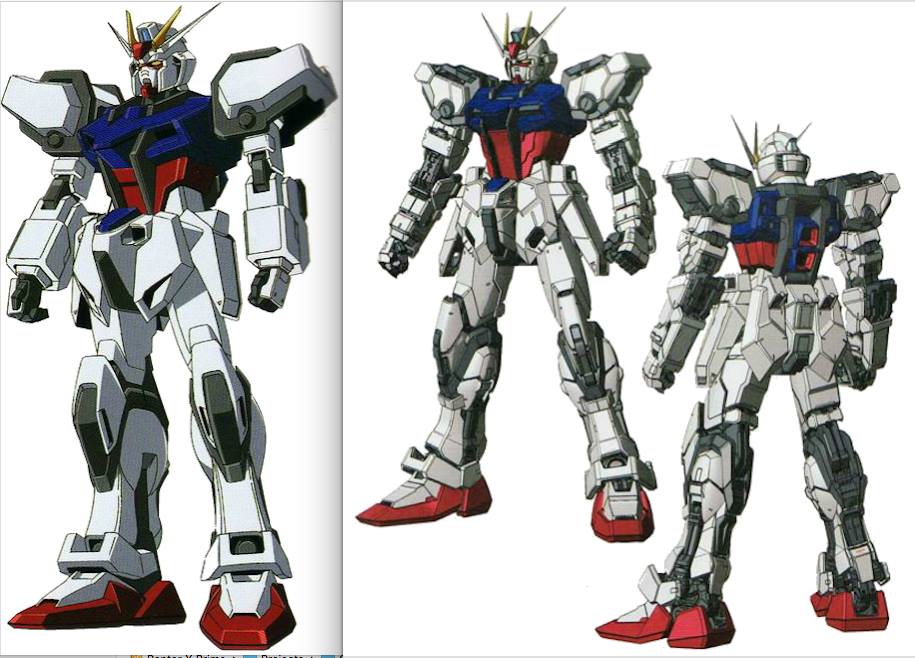
Now, the Strike Gundam can appear and have appeared with slightly different markings and detailing, but, it’s still the Strike. As such, the designation itself can be amended. The one on the left is the original base design of the Strike, the one on the right (front and back) is the one in Gundam Evolve, which is rather close to if not exactly the same as the PG version. So, we can simply put it as GAT-X 105EVO Mobile Suit Strike Gundam Evolve, but, it’s still very much the Gundam SEED Strike even if we drop the EVO tag.

There we have it. A complete brand study. Well, it’s not really that complete yet. With the release of the SEED anime series, kits of the 5 main MS designs (Strike, Aegis, Blitz, Buster and Duel), plus, other MS designs were also released. For simplicity, let’s stick with the Gundam Strike, and I’ll choose the Strike RM kit as an example.

Gundam Strike RM Manual Cover

Based on what i mentioned previously, we have

a) Mobile Suit Gundam SEED, the name of the series.
b) GAT-X 105 Strike Gundam
, the designation of the MS design
c) The design of the MS itself.

So, if any which one of those information is copied, it’s an infringement of Bandai’s copyright and trademark. Now, I keep repeating that on purpose, because a lot of people still can’t wrap their heads around those two terminologies. Copyright and Trademark, though related, aren’t really mutually exclusive. Copyright applies to any written, drawn, recorded form of ideas, either in analog or digital. The Anime Series Mobile Suit Gundam is a copyright of Sotsu • Sunrise. Trademark applies to any visual, audio, formula, design, schematics that a company applies for exclusive use, or for licensing to third parties*.

So, any kit you see that has one or all of the information above, but, does not carry the Bandai branding, is a bootleg. A bootleg is not a brand, that’s why it’s called a bootleg, which is in other terms, a fake. It’s straightforward in Bandai’s case.

But, bootleggers are becoming creative, and when I say creative, they are being devious, exploiting loopholes that make it seem they’ll get away with infringement. It’s worthwhile to repeat that this is the reason why most bootlegs now have fighter instead of Gundam on the plagiarized boxes. Dragon Momoko in turn started designing their own packaging design and boxes, thinking that it lessened if not eliminated the infringement that they have committed. DM’s biggest mistake was claiming copyright over the designs by slapping the © mark on their boxes. Compound that with their penchant for pre-empting Bandai releases, Bandai came down hard on them, harder, compared to what happened to TTH, with the Bandai vs DM court case publicized over social media. It was clear that DM didn’t understand Intellectual Property, or, if they did, they just didn’t care, much like most of those who brandish the fact that they buy bootlegs, and criminalize the evil, monopolistic Bandai empire who never listens to them (just in case some idiot tries to misquote me, I am being sarcastic).

*Third Party

This terminology is the most confusing yet, confounding a lot of people who keep using the term to connote any bootleg kit. In Gunpla manufacturing (or any kind of manufacturing for that matter), Third Party is a legalese term.

Bandai produces plastic kits (Second Party) to sell to consumers (First Party). As such, they require machinery, equipment and materials. They source out suppliers for computers, machines, and plastic beads, and often, they will have more than one supplier at any given time for any given requirement. Those suppliers are Third Party. They are not in any way directly connected to Bandai, but, they have a business-to-business arrangement. Now, as any evolving company would do, they need consistent stock of supplies, so at one point or another, Bandai probably would either buy that company who supplies certain materials to them, they have more control over inventory, or, create a new company, eliminating the need for a third party. Bandai, as we know, fabricate most everything in-house, even the printing and packaging, so the scenario isn’t really far off.

In terms of actual kits being produced, Bandai does not have any third-party affiliates**. A lot of people have been speculating that DM was a Bandai third-party affiliate, because of how close the detail was with Bandai. Master Katsumi Kawaguchi has categorically denied it outright, after an idiot posted a bootleg on his [Kawaguchi’s] wall. Kawaguchi continued to say that Bandai will never resort to giving licensing to third parties when it comes to their kit line, mainly because Bandai has strict quality control.

These same people even rant over DM’s later releases, with add-on details that weren’t on the Bandai kits, as well, as releasing kits Bandai has yet to develop, giving them more ammo to shoot at Bandai’s nefarious schemes, including the much-despised P-Bandai line which a lot of people have developed allergies from.

Add-on parts have been mentioned as 3rd party. Yes, and no. The proper terminology for add-on parts are after-market parts, much like how one buys after-market parts for a car. This is very much a gray area, but, if you’re vying to compete in official Bandai competitions, this is now very much an issue when it comes to your entry. That is why Bandai has been releasing their own after-market add-on parts as well. The same applies especially when you do kit bash.

Now, that doesn’t really mean **Bandai has not had any other companies produce kits for them. If the information is accurate (citation required), Volks, and another company I can’t remember (maybe CVphased), were said to have been licensed to produce C3 event limited 1/144 Messala garage resin kit and a couple of others. But, since these are resin kits, mentioning it is beside the point. 

Resin kits are not Gunpla

Bandai also has production units outside Japan, but for certain specific parts, like the frames for the Metal Build, GFF-MC and HiRM lines are produced in China as well as some of the LED components.

Also, a lot of newbies do not know the difference between Bandai and bootlegs. Whereas it would probably be a little more challenging when built, asking if a kit is Bandai or bootleg, while looking at the box, is a little bit ignorant. If only people start using their common sense, and
Google, they’ll know how to distinguish a kit based on its box with these.

If it walks like a duck, and quacks like a duck...

Of course, there are bootlegs now that don’t even have box art, just huge Kanji/Chinese characters or symbols on plain white/black boxes, just so they can avoid, uh, detection by the IP police.

Update: Bootleggers are now using nondescript boxes to package bootlegs, to deter further scrutiny and make it difficult to spot.
Can you guess what's in the box?

In closing, I don’t give a rat’s ass if you buy bootlegs, it’s your money to waste. Heck, if you buy bootlegs because you’re poor, maybe you should rethink your life decisions and live within your means. Prioritize your necessities instead of entitling yourself to a hobby you can’t possibly maintain, because you are poor.

Regardless, do educate yourself, especially when it comes to Intellectual Property, Copyright and Trademark laws, so you can make informed opinions and better yet, informed decisions. You can keep using the term 3rd party to soften your guilt about buying bootlegs, but, hey, , especially when it comes to Intellectual Property, Copyright and Trademark laws, so you can make informed opinions and better yet, informed decisions. You can keep using the term 3rd party to soften your guilt about buying bootlegs, but, hey, bootlegs are not 3rd party, they’re not even brands, that’s why they’re called bootlegs. Just in case you think this article is curtailing your right to choose the Gunpla brand you want to purchase, or, that it’s good that Bandai has competition in this brand war, well, you only need remember one thing: there is no Gunpla brand war, because there’s only one Gunpla brand. All the rest are bootlegs. If you choose to promote and defend bootlegs, you are well within your right, but, you are defending something illegal and criminal. Also, do not expect people to respect your decision to support a wrong thing. There is nothing respectable about bootlegs, both the production and purchase of it.

See the irony there?

Addendum: Not to be outdone and out-shined in defending its IP, Kotobukiya just had its wannabe lookalike “competitor” Petty Armor shut down, in record time. Hasbro has also started going after bootlegs of its IP.

Move it, Bandai! Kotobukiya is hot on your heels.

Saturday, February 6, 2021

Gunpla™ and Modeling Terminologies


About Kits and Building
  • Kit: That would be what you are building, what will drain your wallet, what will make your Mom/GF/BF/Wife/Husband angry at you (depending on the situation) and will ultimately make you happy.
  • Kit Variant: A recolor or "special" edition of a pre-released kit.
  • P-Bandai: Limited edition kit variants which can only be purchased online through Bandai Hobby Shop, but also through online sellers.
  • Builder: That would be you, the builder of kits.
  • Part: The actual part of the kit used in the build, indicated on the Runner.
  • Runners: The grid of plastic that holds the Parts of the kit.
  • Trees: Same as Runners
  • Sprue: The leftover channel where plastic is injected and expelled (also, Riser).
  • Nubs: The small leftover “lumps” when the Part is cut from the Runner/Gate. Nubs can be thin or thick depending on the Gates it’s connected to.
  • Nubmarks: A mark left after cleaning the Nubs.
  • Gates: The point where the Runner meets the Part of the kit (the entry point of the plastic into the part. In Bandai kits, this is marked with a small arrow, which indicates where one should cut first.
  • Undergate: Gates located under the Part instead of on the side or detail surface.
  • PlaMo: Stands for Plastic Models and refers to plastic model kits for different genres.
  • GunPla®: Stands for Gundam™ Plastic and refers specifically to Gundam Plastic model kits.
  • Resin Kit: A kit made of Resin.
  • Resin Conversion: A type of Resin Kit that uses Resin pieces to convert an existing unit to either an upgraded one or a completely different unit.
  • OOTB: Stands for Out Of The Box. Building a kit as is with no modifications.
  • OOBB: Stands for Out of Box Build. Same as OOTB.
  • Straight Build: Same as OOTB.
  • Kitbash: Combining parts from different kits to make one unique kit.
  • Mods/Modifications: Altering a part for fitting or to change it into something else.
  • Scratchbuild: Completely building a part for a kit (or building a whole MS) from scratch using various materials.
  • Clamshell: Describes two, often mirror parts that are connected together to make a single part, i.e. shoulder sections. A clamshell can be separate parts or two parts of a single mold.
  • Flash Line: Excess plastic excreting from the adjoining edges of a clamshell mold.
  • Seam/Seam Line: The gap between two adjoining parts.
  • Polycaps: Intermediary parts that are made with polyethylene (PE) plastic. These are semi-flexible and are usually used to connect joint sections.
  • Decals: Add-on details that are either paper, foil or clear plastic sticker, dry-rub, or water slide decals. Most kits come with sticker decals, but some come with dry-rub and/or water slides.
  • WIP: Stands for Work In Progress. This would be what a Builder is currently working on.
Kit Types Based on Grade/Scale
  • SD - Super Deformed.
  • SG - 1/200 Speed Grade. These kits are molded in white plastic and comes pre-painted and decaled (limited articulation and poseability).
  • EG - Entry Grade. These kits are molded in 3 colors with no polycaps.
  • FG - 1/144 Stands for First Grade molded in a single color with no polycaps (no articulated elbows and knees, limited poseability).
  • HG - 1/144 Stands for High Grade (Improved articulation and detail).
  • RG - 1/144 Stands for Real Grade (full-frame, small scale, detail and parts separation).
  • NG - 1/100 Stands for No Grade (user appended, technically, non-UC HGs in 1/100 scale).
  • FM - 1/100 Stands for Full Mechanics. Detailed and framed kits that began with the 1/100 Iron-Blooded Orphans series.
  • RE/100 - 1/100 Stands for Reborn. These are 1/100, non-framed, fully-detailed kits from the UC line.
  • MG - 1/100 Stands for Master Grade. Most modern MGs have full inner frames separate from the armor, while some older MGs only have torso core frames.
  • HiRM - 1/100 High Resolution Model. This is a hybrid kit that comes in pre-assembled Die cast Metal and plastic composite frame and armor parts in runners.
  • MB - 1/100 Stands for Metal Build, a line of metal and plastic (PVC) composite figures. Some MB kits have extra pre-cut parts for assembly.
  • GFF-MC - 1/100 Stands for Gundam Fix Figuration Metal Composite, a line of of metal and plastic (PVC) composite figures which are similar if not the same as and precursors of MBs.
  • PG - 1/60 Stands for Perfect Grade (full articulation and parts separation).
  • MS - 1/60 Stands for Metal Structure figure.
  • verKa - a series of kits designed from ground up, including engineering of the kits to the creatives for packaging and manual design by Hajime Katoki. They are packaged in signature white boxes
Plastic Types
  • PVC: Stands for polyvinyl chloride. A type of plastic used in certain Gunpla kits and figures.
  • PE: Stands for polyethylene. A type of plastic used in polycaps.
  • PS: Stands for polystyrene. A type of plastic used in Gunpla kits. Used mostly in armor pieces. Some HG are all PS.
  • PP - Stands for polypropylene. A type of plastic used in Gunpla kits similar to PE but stiffer and denser, used in combination with ABS in manipulators and joints (in RGs, PGs and v3.0 manipulators).
  • ABS: Stands for acrylonitrile butadiene styrene. A type of plastic used in GunPla kits. Used mostly in MG/PG frames and in some HG pseudo frames, ABS is a tough but flexible plastic. Sensitivity to cement varies depending on the color of the ABS, with black being the toughest, and red the most receptive to cement.
  • Resin: A type of material used on some non-plastic kits.
  • TPE: Stands for Thermoplastic Elastomer. This is the rubbery plastic in some older MGs (like the rubber hands and feet of G-Gundam kits) and the wing tips of the PG Wing Zero Custom.
Painting
  • Airbrush: A paint application tool.
  • AB: Stands for Airbrush
  • Hand Paint: Applying paint by hand with brushes.
  • Hand Brush: Same as Hand Paint.
  • Spraycan: Canned pressurized paint with a nozzle that serves as the applicator.
  • Rattlecan: Another term for Spraycans.
  • Decant: The process of expelling air, then the paint, from rattlecans for later use in AB.
  • Primer: A chemical used to prepare a surface to be painted. Not to be confused as a type of Paint. Primer is (slightly) chemically different to regular paint. Can also mean the application of a coat of Primer (prime).
  • Paint: A chemical used on surfaces to give it color.
  • Acrylic: A type of Paint. Weakest of the three main Paint types. Most acrylics are water-based and can be thinned by plain water, but, becomes water-resistant when dry/cured.
  • Enamel: A type of Paint. Middle ground when it comes to Paint types. Enamels can be thinned by enamel thinners.
  • Lacquer: A Type of Paint or Thinner. Strongest among the three Paint types. Lacquer is basically varnish mixed with colors. Lacquer can be combined with Acrylic bases, and can be thinned or stripped with alcohol.
  • Thinner: A chemical used for Thinning or Reducing paint.
  • Thinning: Adding Thinner to Paint to make it more fluid/less viscous.
  • Retarder: A chemical added to Paint to slow down its drying time, giving it a chance to settle down and self-level. Usually used on Acrylics and replaces Thinner.
  • Top Coat: A clear, colorless type of Paint used to seal and protect Paint layers.
  • Flat: A type of Paint or Top Coat or finish that is not shiny or glossy.
  • Matte/Satin: A finish midway between flat and glossy.
  • Gloss: A type of Paint or Top Coat or paint finish that is shiny or glossy.
  • Semi-Gloss: Same or similar to Matte.
  • Future: A type of glossy floor coat used as acrylic top coat that can be applied by Hand Brushing or with an AB.
  • Base/Buffer Coat: The first Layer of paint. Applied after Primer if Primer is used. Used to set the tone of the Color Coat. Can be skipped by using the corresponding Primer color.
  • Color Coat: The coat of paint that the will be the surface’s final color.
  • Candy Tone: A technique of using a clear paint over a metallic buffer.
  • Pooling: Paint collecting in a certain spot mostly on the edges and panel details, usually from a very thick coat of paint, or from Runs.
  • Runs: Paint that is flowing on the surface, usually due a thick coat of paint and pulled by gravity and collects in Pools.
  • Brushstroke: The direction a paint brush is going. Can also mean the same as Brush marks.
  • Brush marks: Fine lines left by brushes after every stroke.
  • Autolevel: A Paint property where the Paint makes itself smooth and level on its own as it dries.
  • Leveler: A chemical added to paint to make paint level and smooth as it dries.
  • Retarder: a chemical additive that delays the drying of paint to allow it to settle and level properly.
  • Overspray: Excess paint that accumulates (in details, edges and panel lines) because of too close a spray distance or too much pressure.
  • Misting: a technique employed in AB and spraycan painting where parts are coated with paint mist over a significant distance. Paint build up is slow, but more even, requiring more than just the usual number of coats compared to the closer distance. Ideal for spraycan painting.
  • Masking: The process of covering certain sections of parts with masking tape or masking solution to shield a previous layer of paint from a new layer of a different color, to create color separation.
  • Orange Peel: The results when spraying too much paint or laying down one coat after the other and not allowing the previous coat to fully dry. It can also be caused by uneven or unprimed surfaces This very much looks like how orange skin looks like, with pits and bumps.
  • Bottom-feed: A type of AB where the paint container is at the bottom.
  • Siphon-feed: Same as Bottom-Feed.
  • Gravity-feed: A type of AB where the paint container is at the top.
  • Side-feed: A type of AB where the paint container is at the side.
  • Dual-action: A type of AB trigger where two actions are done to start spraying. First, pressing down on the trigger starts the air flow, while pulling it back on trigger sprays the paint.
  • Single-Action: A type of AB trigger where pressing down on the trigger will release both air and paint.
  • Internal Mix: A type of AB where the mixing of paint and air in done internally.
  • External Mix: A type of AB where the mixing of paint and air in done externally as air is expelled.
  • Comp: Short for Compressor, a machine that provides air for ABs.
  • PSI: Stands for Pounds per Square Inch. the amount of pressure released by a Compressor.
  • Working Pressure: The PSI a Compressor is set to while it is being used.
Tools and Materials
  • Side Cutter/Nipper: A tool used to remove Parts from Runners.
  • Hobby Knife: A multipurpose pointed straight edge blade mounted on a shaft.
  • Markers: Pens used for Panel Lining and Detailing.
  • Sandpaper: Abrasive sheets of various grits used to smooth rough surfaces and remove scratches.
  • Sanding board: A tool that looks like a manicurist’s emery board used for sanding.
  • Sanding sticks: Same as/similar to Sanding boards.
  • Grit: A unit of measure of how rough sandpaper is. The lower the grit, the rougher the sandpaper.
  • Putty: Used in making repairs and filling.
  • Scribing Tool: A tool use for Scribing panel lines. There are specific scribing tools and chisels, but one can use blunted knife blades and compass needle points for scribing.
  • Cement: A type of adhesive used in GunPla building.
  • CA Glue/Superglue: CA stands for Cyano Acrylate, which is a resin-based glue.
  • Dremel/Router: A multipurpose electric hand tool used for cutting, carving, sanding, grinding, and buffing.
  • Pin-Vise: A hand tool used to hold micro drill bits and pins.
  • Plaplates/Polystyrene Sheets: Sheets of plastic with varying thickness used in Scratchbuilding. “Plaplates” is a brand specific to Tamiya.
  • HIPS: Stands for High Impact PolyStyrene. Same as/similar to Plaplates.
Detailing
  • Decals: Detail markings on kits.
  • Waterslide: A type of Decals that needs water to apply and adhere.
  • Rub-On: A type of Decal that is rubbed-on the surface to apply.
  • Sticker: Decals with adhesives
  • Dry Transfer: Same as Rub-On.
  • Panel Line: Lines and groves on the surface and lines where angles meet.
  • Panel Lining: Filling in Panel Lines with color.
Techniques
  • Progressive Sanding: Technique used to remove nubs or make surfaces smooth with sandpaper by increasing sandpaper grit gradually starting from coarse to fine.
  • Buffing: Process of rubbing cured paint (or even bare plastic) to make it smooth and shiny.
  • Rubbing: Same as Buffing
  • Pre-shade: A type of shading technique where shading is added before the Color Coat is applied.
  • Post-shade: A type of shading technique where shading is added after the Color Coat is applied.
  • Wash: An advanced painting technique. Can also be a very thinned mixture of paint and thinner used for various Washing purposes.
  • Panel Line Wash: A type of Wash technique used to paint Panel Lines.
  • Spot Wash: A type of Wash technique used in Weathering.
  • Reverse Wash: An painting technique similar to a Wash but in reverse.
  • Mod: Short for Modifications.
  • Weathering: Applying details and shades to a kit to give it a more realistic look.
  • Scribing: Adding Panel Lines to the surfaces of a kit.
  • Drybrushing: A Painting/Weathering technique.
  • Battle Damage: Adding details on a kit to simulate the look of going through a battle.
  • Plaplating/PS Plating: Armor detailing with pieces of shaped plaplates or HIPS.
Slangs
  • Hiatus: Means to take a break from a certain activity or from work. In GunPla Terms, “Pinipilit umiwas sa tukso” (avoiding all temptation).
  • PNP: Stands for “P**A, nalaglag/nawawala part/polycap!” In English: “Sonnavab***ch/F**K, I lost a part/polycap!” 
  • Blackhole: When a part one is working on slips or flies from one's grip into the unknown, comes right after PNP.
  • Dibs: English slang. Usually means “Akin na yan, ako ang unang nakakita” (It's mine, I saw it first). Muttered when someone offers a kit/set for sale that's too good to pass up.
  • Haul: items purchased (Having All U Like) often in bulk.
  • Backlog: Stash of unbuilt kits
Timelines
  • UC - Universal Century, starts from UC0068 (origins) to UC 0223 (G-Savior)
  • FC - Future Century (G-Gundam)
  • AC -After Colony (Gundam Wing)
  • EW - Endless Waltz (Gundam Wing)
  • MC - Mars Colony (Frozen Teardrop)
  • AW - After War (Gundam X)
  • CC - Correct Century (Turn X)
  • CE - Cosmic Era (SEED/Destiny/Astray)
  • AD - Anno Domini (Gundam 00)
  • AG - Advance Generation (AGE)
  • RC - Regild Century (Reconguista)
  • PD - Post Disaster (Iron Blooded Orphans)
  • BF/BD - Build Fighters / Build Divers. A set of overlapping series that tell stories about Gunpla building and competitions.
Miscellaneous
  • Shiny/Glossy Finish: A surface finish that reflects light. Ideal for showroom or just-out-of-the-factory concepts.
  • Matte Finish: A dull surface finish that reflects little light. Ideal for week/month-old effects and a precursor to weathered/battle-damaged effects.
  • Mirror-like Finish: A surface finish that reflects light and images, mostly achieved with chrome paints.

Wednesday, January 27, 2021

A Guide to Gunpla Scales and Grades

Gunpla “grades" are scale and complexity indicators. You should be able to start building any grade without difficulty, as long as you follow the pictogram instructions. More recent Bandai kits also have English Instructions.

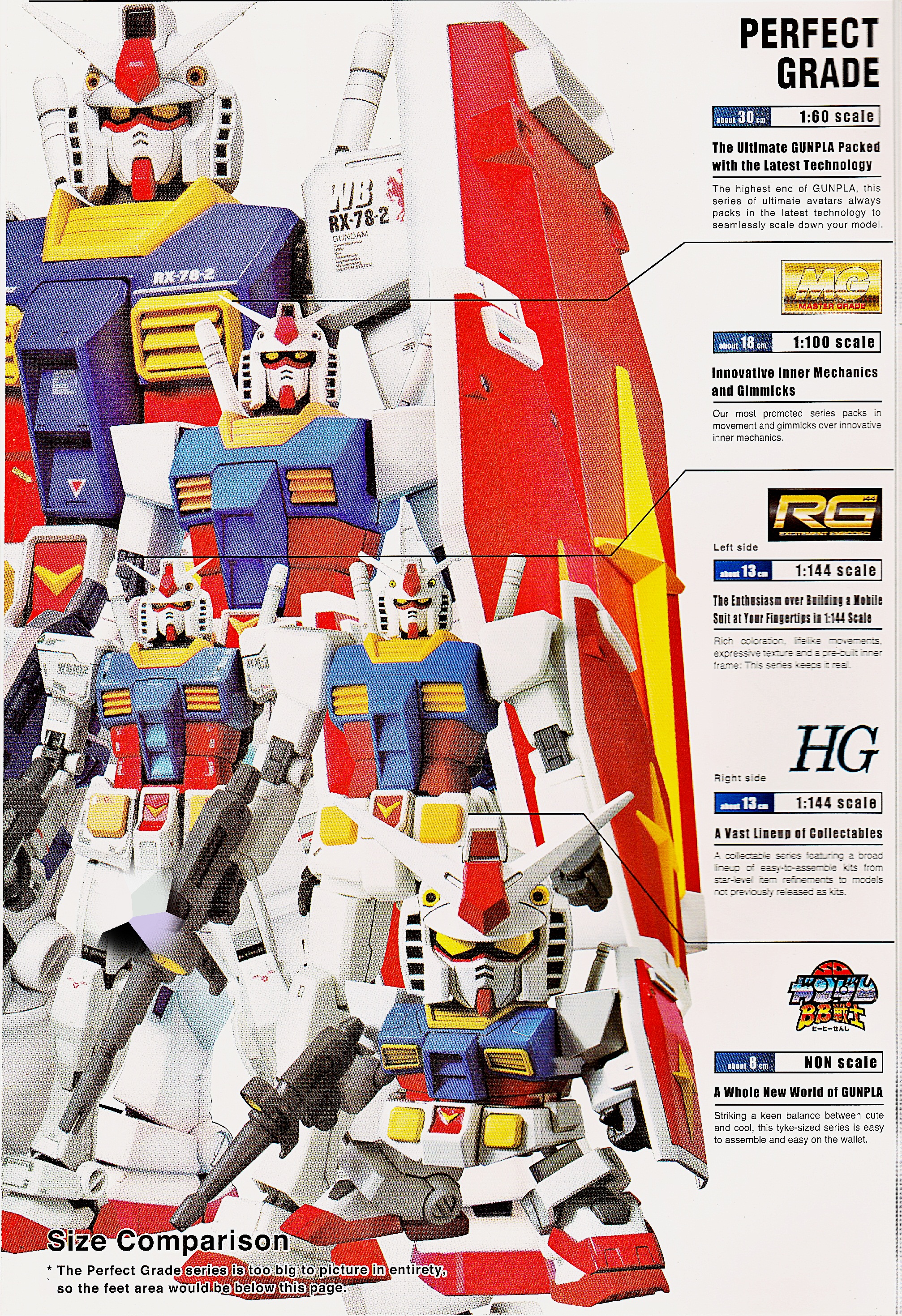
1/144 scale

  • High Grade (HG) which is a relatively simple build, often without any frame and mostly lack details. HGs are the cheapest among the grades, most abundant, available, and the HG line has the widest range of kit designs and variants. Most MS designs are released as HGs. Some HGs have rudimentary "pseudo" frames, like the Sazabi and K'shatriya. The HG series are appended by the anime series Universe, ie, HGUC, HG00, HGAC, etc. The HGIBO is the first line that feature internal frames.
  • Real Grade (RG) has an internal frame like modern MGs. RG frames are mostly pre-assembled in sections and the armor parts are heavily detailed. Only select MS designs (main protagonist and antagonist suits) are released as RGs.
  • Entry Grades (EG) and First Grades (FG) are 1/144 scale kits intended for younger builders for quick building, do not have polycaps, and lack articulation and detail. EGs are molded in 3 colors, while FGs are molded in white PS plastic. The new Entry Grade Gundam RX78-2, however, features better articulation.
  • 1/200 Speed Grade. These are preformed and prepainted kits that come in a single runner.

1/100 scale

  • 1/100 HG is just like the name implies. They are 1/100 scale High Grade kits released in the 90s. The only series released in this scale/grade are the Gundam Wing and Gundam X (afaik).
  • 1/100 Non-Grades (NG) or simply 1/100 scale (the NG is user-appended) are similar to HGs. They don't have internal frames, and they often lack details. They are the cheapest among 1/100 scales, and MS kits released in NG/100 are from the non-UC series.
  • RE/100 (Reborn series) are "rebranded" 1/100 scale. They are similar to NGs that they do not have internal frames, but do have ample details. The kits released in this line so far are from the UC series.
  • 1/100 IBO. These kits come with simple internal frames and detailed armor parts. The articulation is rudimentary, but still good compared to other regular 1/100 scale.
  • 1/100 FM. Stands for Full Mechanics and replaces the 1/100 IBO full frame tag.
  • The Master Grade (MG) has an internal frame, often with intricate details and complex articulation mechanisms. Most modern MGs (2.0 and 3.0) have full inner frames, whereas older ones only have partial inner frames.
  • The Master Grade verKa. A distinct line of Master Grades designed, Engineered and Produced by Master Designer Hajime Katoki. The verKa line is also easily identifiable with its distinct white box.
  • Master Grade Extreme (MGEX) - The MGEX is marketed as a next-level Master Grade that goes beyond the detail of its predecessor. First in line is the MGEX Unicorn, which is marketed to have improved articulation, detail and houses an RGB LED lighting system along with a dedicated MS Cage. Next in line is the MGEX Strike Freedom.
  • GFF-MC and Metal Build. These are composite figures, with metal die-cast and PVC plastic parts. Though categorized as non-scale. these figures are based on 1/100 scale heights. Most are standalone figures, though some have swappable parts, like the MB Exia/R3. GFF-MC Stands for Gundam Fix Figuration Metal Composite. Up until recently, the GFF-MC line have all been UC MS, but the F91 is released as GFF-MC feat Metal Build, while the Wing Zero Custom is released as GFF-MC.
  • High Resolution Model (HiRM). This new line of metal composites is a hybrid figure/kit comes with a hybrid die-cast metal/plastic frame, and plastic armor parts still on runners, which gives collectors the chance to assemble the parts themselves. The first to be released in this line is the IBO Barbatos and P-Bandai Barbatos 6th Form. The Wing Zero and Red Frame Astray were each released a year after each other. The most recent release was the HiRM God Gundam, which were preceded by the Wing Endless Waltz and Astray Noir respectively.

1/60 scale and higher

  • 1/60 kits are just scaled up HGs/NGs, with no inner frames. These kits lack detail and with minimal articulation. There are only a few kits released in this line (like the Exia, Strike Freedom, Shining/God Gundam, Freedom, et al), in very low circulation.
  • The Perfect Grade (PG) line has plenty of parts owing to its size. Earlier PGs have very complicated frame assemblies (up to the GPO1/FB), with modern ones having a <simpler> yet robust frame assembly (starting from the Strike). The latest in the PG line is the Perfect Strike Gundam, which basically the PG Strike with Launcher and Sword Striker packs. 
  • The Perfect Grade Unleashed (PGU) - Is an upgraded PG, with a more complex frame and armor assembly as well as metal detail parts. The first in the line is the PGU RX 78-2.
  • 1/35 Jumbo Grade is really more like a scaled up HG, no internal frame and limited in articulation and detail.
  • 1/48 Mega Size. This line is simply scaled-up HGs, with very minimal articulation and detail. These are mostly display pieces.

SD Kits

SD or Super Deformed kits are Gunpla kits that are not based on any scale, but rather on deformed proportion as basis for cuteness, specifically having very large heads and comically anime eyes. They offer a very limited articulation and require much more attention for details and painting. To compensate for lack of detail, some SD kits have very large sticker pads included, while other SD kits have an extra gimmick not shown in their normal counterparts. One of the most common SD kits in Japan are based on the Plamo-Kyoshiro’s Musha Gundam line.

The most current iteration of SD kits is the SD Gundam EX-Standard (SDEX) which are based on the current Gundam models in SD size. They are cheaper to produce and have more articulation than the previous SD kits, though is more lacking in plastic production as some parts (especially in the limbs) are left hollow to compensate on its cheap cost.

Recently released is the SD Cross Silhouette series. These SD kits come with and can be assembled on a generic internal frame and allows builders to mix and match parts from different kits as well as set different proportions by using the Cross Silhouette frame.

https://cdn.store-assets.com/s/209038/f/639721.jpg
Source: https://www.ohmygundam.com.my/blogs/blog/gundam-size-comparison


The Newbie Stash

Source This is a collection of specific guides for reference in Gunpla Building and Modeling in General.  • Gunpla™ and Modeling Terminolog...