Showing posts with label spray cans. Show all posts

Saturday, November 1, 2014

Demystifying Bosny Spray Cans


With the intent of going full AB, dropping if not minimizing my use of Bosny spray cans, I got an Airbrush + compressor set from a friend who decided to sell his unused set a couple of years ago (he was leaving to work abroad back then).  So far, I haven't been able to use the the darned thing since I really don't paint that much.  I don't even paint the kits I have modified, lest I really have to, and that I suppose is one of my many faults as a Gunpla "modeler," making it seem that I don't finish anything.

Accessibility and Practicality

Bosny spray cans are easily accessible.  Hardware stores all around carry them, and they are rather cheap for one-off paint projects.  They are handy, as such, you can't really run out of it if you have enough stocks on-hand, so you won't have to leave a project hanging.  Of course a little planning is always involved in the process even with AB painting, making sure you have enough stock of whichever color of whichever paint of whichever process one utilizes so that one does not run out of paint or material midway during a build.

Provided you source out the cheapest, to which, this is no big secret, I buy mostly "in bulk" at Pasilio 1C 168 Mall at Divisoria, cans are relatively economical, though someone did point out earlier with the number of cans I've already used, I could have gotten an AB.  He of course is correct with regards to the economics, but with the small space I have, and the time constraints, painting with AB is such a time-consuming process.  I will have to plan each color pass down to the smallest part and paint those in sequence, something I don't really need to do with cans.  If I miss something, or, make a mistake, I can simply start over without having to worry about the original setup.  I also do not have to worry about mixing paints.

As I mentioned, I did get an AB eventually (two ABs, in fact, I have gotten one earlier as a freebie), but, as of this writing and as I have mentioned previously, I haven't even broken-in those two and the compressor.

For me, the practical advantage of using cans is the convenience;  even if I run out, I can simply run to the nearest hardware store which is actually just walking distance (see what I did there) to get a fresh can or two of the color I need (provided of course, it didn't happen at night).  But, I've been using cans well long enough to know if I'll run out or not.  I can easily estimate how many cans I'll be using for a project, assessing the amount BEFORE I even start painting.  More so, I've started stocking up on the colors I frequently use, specifically the grey primer, Honda Red, Nickel, flat white and flat black, since I essentially use them all the time.

Too Close, Too Thick for Comfort


A lot of people mistake that paint in cans are too thick, especially with industrial ones like Bosny.  They are partially right, because these paint cans are really made for use on cars and large surfaces, as such, they are designed to accumulate more readily, coat quickly and dry quickly.  On my first attempts at painting with cans, I've screwed up several times.  The most common mistake is spraying too close and overspraying.


Bosny Metallic Red tends to be too thick
especially when sprayed too close

Also, Bosny cans are not equally thick across the board.  Some are actually rather thin, like Primer Grey and Flat Black, and do take a few passes to get enough coverage.  The above photo shows my first experiment on painting with Bosny Flat Black, Gold 351 and Metallic Red, all sprayed too close.  You can see how thick the paint is on the edges, even with Bosny surprisingly having a self-leveling property.

Bosny is quick drying, provided certain conditions are met. Spraying too close leaves the underlying layer of paint wet and uncured for hours, and with varying humidity, the difference of dryness between layers can cause that nasty surface "curl" effect when the upper coat dries faster than the lower one.

The Distance Between Us


The standard distance I've been using was 6 inches, but through the months I've been experimenting, I've determined that the best distance is actually around 12 inches from the surface, in quick bursts, effectively misting the paint.  Misting keeps the paint particles small, and it allows the paint to dry halfway and fully as it lands on the surface. 


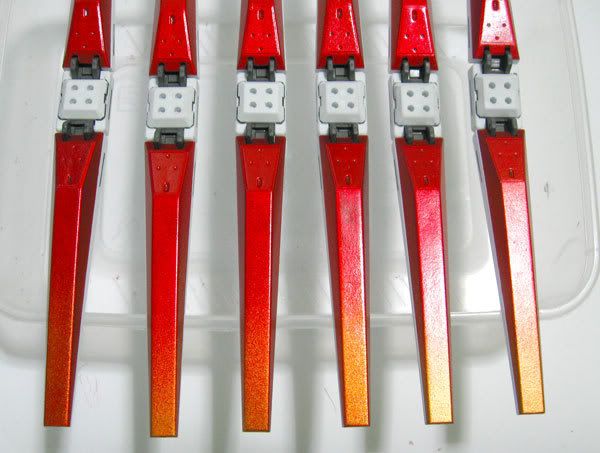
My first attempt with the MatX Multitone/Color Change/Gradient,
which back then, no one really attempted with cans.  This is achieved
with Flat Black, then Gold 351 and Honda Red 67
sprayed at opposite angles to create the gradient effect

I've stopped using Bosny Metallic Red (along with Metallic Blue and Metallic Black) back then because even with dry conditions and considerable spray distance it still tends to be too thick.  The Bosny Metallics are also opaque, so it was pretty useless having laid down a layer of gold before it, which also contributed to thickness.

So far, I've found that Bosny Gold, Silver, Aluminum, Aluminum Silver and Metallic Silver are good buffer paints for clear and candy tones.  With misting, they can cover a part without obscuring the details.  The photos above and below show my first attempts with the buffer/candy tone technique, and discovered quite by accident that spraying at opposite angles could create a somewhat color change depending on the angle to which the light hits the painted part, which is actually more of a gradient.


Though I've seen gradients done quite easily done with AB, I haven't seen anyone else do this with cans on small parts back then.

The Myth Behind the Mist

There is no singular technique in achieving a great paint job with cans, but, the best technique so far, at least for me, is misting.  The main issue people have with it is paint wastage; misting does require one to spray at a more significant distance, and the farther you spray, the larger the spray diameter.  So people will always tend to spray closer to economize on paint, without realizing that that method is actually more unpredictable, especially since cans do lose pressure as the paint is expended.  The result; overspray and uneven coats.

Misting allows one to gauge where and how the paint lands on a certain surface, and not all surfaces get painted the same way.  People also make the mistake of keeping the can stationary while depressing the nozzle.  Both the part and can must be moving constantly in opposite directions, with curved parts rotated as the paint is misted to give it more coverage.  Misting keeps the paint particles small, and as I have mentioned early, dry quickly as it lands on the surface.


With misting, I've been able to avoid overspray and achieve a paint layer close to that of an AB (of course, I wouldn't want to argue with any AB user that it's the same, hence "close").  The above shows several coats of Flat Black, Nickel Chrome and Honda Red 67 (which takes a LOT of passes to achieve a full coat), and as you can see, the surface details remain clear even after the Flat Clear (which creates the muted metallic/red titanium effect).

Compare that to a relatively <simpler> Titanium White (Flat White, Pearl White, Flat Clear)


The Only Drawback

So far, the only drawback with Bosny paints is that it has a very "limited" range of colors.  I don't follow recommended color schemes anyway, more so, I often use my favorite color, RED and variants of it, so, that has never been an issue to me.  But recently, I've been experimenting on combining flat and candytones to create new colors.

Bosny recently introduced the White Pearl, a semi-clear pearlescent white "top coat," along with Flat Clear, which is what I've used to create the titanium-white effect with the Stein.  Using pearl white over ANY color gives it a dulled-down pearl/glittery effect.

Bottom: Standard metallic buffer>clear red>flat clear combo.
Top: with Bosny White Pearl

White Pearl creates a lighter, almost pinkish red tone, somewhat like an "old rose" feel to it.  This expands the color scheme a bit, as such, I can use it for any "Char" mobile suit variation, instead of the "salmon pink" which actually more orange.  Adjusting the densities of the buffer, candy tone and White Pearl creates subtle color variances which I can use to enhance gradient effects.

There's also Black Tint, a "clear black" top coat, which is equivalent to Tamiya's "Smoke."

Left: Bosny Gold 351
Right: with Bosny Black Tint
Left: Standard Candytone Red
Right: with Bosny BlackTint

Black Tint gives regular colors a darker shade, with the added effect of being almost black in some sections depending on the angle of light as the part curves.

It's also worthwhile to note that Don Suratos aka DC23, won his first BAKUC World Championship with a split-color Kampfer painted with Bosny.  He was actually the one who inspired me to paint with cans.


Thursday, November 4, 2010

Black Red, and Gold!

  
The expert who didn't want to argue is still arguing about the difference of injection molded plastics and sheet plastic when I've reiterated it had no bearing in the discussion, and the one who claims to be ignoring me and my posts is checking out my blog.

Kewl.  I've always known that guy was too insecure for his own good.  I don't often talk about issues like these on my blog, not that I don't consider them any less important, but there are times that even I run out of patience or get annoyed with the very same type of people.  I'm still human after all.

Anyways, Murphy's starting to rear his ugly head as I enter the final leg of the build and, I realized the grainyness of the metallics are quite reduced if I don't layer them with black or another color.
Here's the shield of the Angelus.  The gold stands out quite nicely against the black and red.  The "Stringy" texture is done by scribbling lines using Technical pen over Flat Black.  The India ink dries semi gloss.  It's one of those techniques I discovered quite by accident back in the days I was drawing/coloring heavily on paper (there weren't computers or Adobe for that matter).  I'd often use ink over flat black poster color, and sometimes, through an overshoot of dexterity or being too careful, I'd overshoot my target line and into the flat black.  Later I realized it could be used to my benefit, as you see now.

I made a few mistakes removing the mask and the red edges are quite uneven.  I might be able to fix those with clear red enamel later on.


Tuesday, July 20, 2010

Misconceptions about Paints...

I was posting very frequently in several forums a while back and the most common question I get when it comes to painting is "What paint do you use?"  My usual response was "I use Bosny and/or RJ London paints, and they are basically Acrylic Epoxy Lacquer Paints.  In the modeling arena, people only know either Lacquer, Enamel, or Acrylic paints, and seeing a paint type like Acrylic Epoxy Lacquer was a bit of a stretch.  In one such forum, one even told me to make up my mind if I was using either Lacquer or Acrylic because that person couldn't quite accept having both in the same paint (even after showing the label), and another one even said that "Epoxies" are two part glues that can't be added in spray can paints. One thought that it might just be regional naming conventions because I was living in the Philippines.  To quote him verbatim:

"Maybe It has to do with your country's use of english, As the definition of lacquer is a mixture of natural resin and pigment ( modern day we use chemicals). Comes from the Portuguese word lac, and they used it long ago as an alternative to tempera.  And I have never seen the term epoxy used like that.
 
Again I am not trying to tell you your wrong, as it seems like our countries must use the words differently."

The thing is, Bosny and RJ London are European formulas manufactured in Thailand.

Definitions-wise:

"1673, from Fr. lacre "a kind of sealing wax," from Port. lacre, unexplained variant of lacca "resinous substance," from Arabic lakk, from Pers. lak (see lac). The verb meaning "to cover or coat with laqueur" is from 1688."


From Dictionary.com:

–noun
1.
a protective coating consisting of a resin, cellulose ester, or both, dissolved in a volatile solvent, sometimes with pigment added.
2.
any of various resinous varnishes, esp. a resinous varnish obtained from a Japanese tree, Rhus verniciflua, used to produce a highly polished, lustrous surface on wood or the like.

It's a common misconception that the term "lacquer" corresponds directly to paint (or a paint type). Lacquer is actually a type of varnish (the other type is polyurethane, like Future, and even some acrylic varnishes) that is mixed with paints or pigments (mostly with automotive spray paints) that give finishes their lovely shine. 

Epoxy, on the other hand, is mixed with paint (or pigment) to increase its bond, its quick-drying property and overall strength. Epoxy paints are more resistant to light scratches. Hence, these types of paints actually don't need to be top coated unless you want extra protection (or that uber shine).  Epoxy is a term often associated with glue, but in itself is a resin-based "hardener."  That's why we call those two part glues as "epoxy" glues; one is the binder/glue, the other is the hardener/epoxy.  Also, epoxy can't cure sealed under pressure, and only when it get exposed to air or a certain temperature range does it start to harden.

Acrylic, in turn, is a base for pigments, much like how some paints have enamel and latex bases.  Acrylic and latex paints are water soluble and therefore can be thinned with plain  water.  Enamels are not, and require enamel thinners.

So, a Lacquer Acrylic Epoxy paint has 3 components; an acrylic-based pigment, epoxy to harden it, and lacquer to give it shine.  


Saturday, July 17, 2010

QnA: Of Spray Cans and Plaplate Scratchbuilding...

--- On Sun, 7/18/10, Peter PUN  wrote:

From: Peter PUN
Subject: questions haha
Date: Sunday, July 18, 2010, 12:16 AM

hello man this is probaly quiet random but like i want to ask you how you paint your models? Do you hand brush them or spray paint it or airbrush :S ?

And one more haha!  i've been inspired by your scratch builds and i want to try it myself, i know nothing about it unfortunately :(

but but but i really want to know like.. i dont understand how you cant the pieces off a pla plate, i dont know how to glue them together and stuff could you give me a brief outlien on this when you have the time, that would be awesomely lovely :D.

well thanks in advance for reading my email :],

from a stranger who enjoys your scratch builds!

I use spray cans exclusively, and from time to time, use the dry brush method to paint frames.

As for scratch building, I'm not sure what you want to know specifically.  I almost exclusively use cement for scratch building, and use cutter knives, art knives, scissors and side cutters in combination depending on the shape I am trying to achieve.

Most of my posts and tutorials are rather already descriptive and pictorial, so you can just reference them for now.

Monday, July 12, 2010

A Query via Email...

I got this email from JML (his initials), asking me about my painting process.  It's in Tagalog, but he simply asked about the Semco acrylic paints and if I used an Airbrush (AB).

This got me thinking, why not make this a regular segment?  I will post email queries and make it part of my blog in the Tutorials section so everyone can benefit from it.


--- On Mon, 7/12/10, JML<***************@gmail.com> wrote:

From: JML
Subject: re: painting
To: xanderx007@yahoo.com
Date: Monday, July 12, 2010, 10:40 PM

Hi sir xander, pahabol na tanong lang sir, curious lang ako nakita ko na gumamit ka ng semco paints for your Ronin Astray project so gusto ko lang malaman kung ok ba syang gamitin sa mga kits? also sir gumagamit ba kayo ng Airbrush kasi parang napansin ko na wala kayong ginamit na AB sa mga build niyo? at yung mga bosny paint na ginamit niyo is there any way to recreate them using AB kung may idea lang po kayo kasi parang pakiramdam ko if I use an spray can I would just mess it up, I don't I haven't tried it yet pero nagbabalak ako pagka kumpleto na ko kasi madami na kong nakatamabak na kits na gusto ko sanang gawin OOB pero I'm still practicing at magkukumpleto pa ko ng mga gamit at materials para hindi mahirap, well sir goodluck sa mga builds at sinusundan ko yung blog mo ang lupet lalo na yung big red.well sir thanks sa time and looking forward to your future builds

JML,

I was planning to use the semco acrylics for the dio, which I haven't finished.  For kits, I paint exclusively with Bosny and RJ spray cans.  Both Cans and AB can be messy if you don't know what you're doing, in a rush or not careful.

The gradient/multitone schemes are actually easier and finer with an AB than with cans, but, I prefer not to invest on an AB because I wouldn't have other practical uses for it and would only be laying around when I'm not doing gunpla.  I prefer the throw-away convenience of cans as well as the the texture I can achieve with metallic paints.  I prefer texture/grainyness over a smooth texture because it gives the paint job its identity.

Monday, April 12, 2010

MatX's Mutitones with Spray Cans


The Two Tone effect

What you'll need:

Bosny Flat White (Primer), Bosny 351 Gold, RJL 08+1580 Yamaha Red, sturdy hands and a LOT of patience. (You can use substitute similar type paints that are available in your area, but make sure that the Red you are going to use is semitransparent, meaning, if you spray it over black, you will still see black).

Do this,

http://www.youtube.c...h?v=2pm-yLBdpWE

http://www.youtube.c...h?v=HJBXRhYj5nM

To achieve this,

Posted Image

Posted Image

Sherlock Holmes [Blu-ray]Soldier of Love

The Newbie Stash

Source This is a collection of specific guides for reference in Gunpla Building and Modeling in General.  • Gunpla™ and Modeling Terminolog...