Accessibility and Practicality
Bosny spray cans are easily accessible. Hardware stores all around carry them, and they are rather cheap for one-off paint projects. They are handy, as such, you can't really run out of it if you have enough stocks on-hand, so you won't have to leave a project hanging. Of course a little planning is always involved in the process even with AB painting, making sure you have enough stock of whichever color of whichever paint of whichever process one utilizes so that one does not run out of paint or material midway during a build.
Provided you source out the cheapest, to which, this is no big secret, I buy mostly "in bulk" at Pasilio 1C 168 Mall at Divisoria, cans are relatively economical, though someone did point out earlier with the number of cans I've already used, I could have gotten an AB. He of course is correct with regards to the economics, but with the small space I have, and the time constraints, painting with AB is such a time-consuming process. I will have to plan each color pass down to the smallest part and paint those in sequence, something I don't really need to do with cans. If I miss something, or, make a mistake, I can simply start over without having to worry about the original setup. I also do not have to worry about mixing paints.
As I mentioned, I did get an AB eventually (two ABs, in fact, I have gotten one earlier as a freebie), but, as of this writing and as I have mentioned previously, I haven't even broken-in those two and the compressor.
For me, the practical advantage of using cans is the convenience; even if I run out, I can simply run to the nearest hardware store which is actually just walking distance (see what I did there) to get a fresh can or two of the color I need (provided of course, it didn't happen at night). But, I've been using cans well long enough to know if I'll run out or not. I can easily estimate how many cans I'll be using for a project, assessing the amount BEFORE I even start painting. More so, I've started stocking up on the colors I frequently use, specifically the grey primer, Honda Red, Nickel, flat white and flat black, since I essentially use them all the time.
Too Close, Too Thick for Comfort
A lot of people mistake that paint in cans are too thick, especially with industrial ones like Bosny. They are partially right, because these paint cans are really made for use on cars and large surfaces, as such, they are designed to accumulate more readily, coat quickly and dry quickly. On my first attempts at painting with cans, I've screwed up several times. The most common mistake is spraying too close and overspraying.

 |
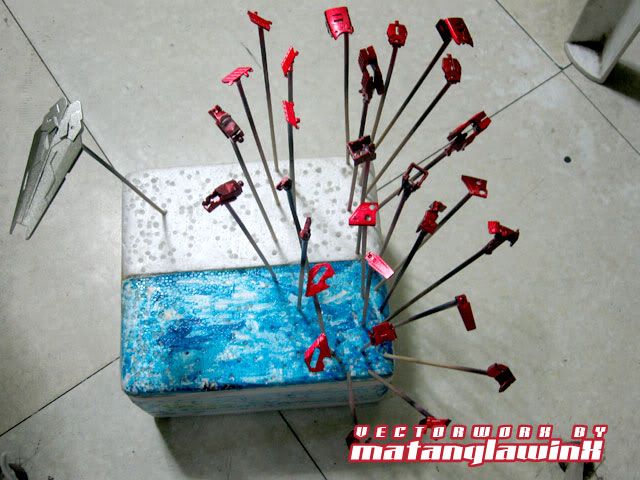
Bosny Metallic Red tends to be too thick especially when sprayed too close |
Also, Bosny cans are not equally thick across the board. Some are actually rather thin, like Primer Grey and Flat Black, and do take a few passes to get enough coverage. The above photo shows my first experiment on painting with Bosny Flat Black, Gold 351 and Metallic Red, all sprayed too close. You can see how thick the paint is on the edges, even with Bosny surprisingly having a self-leveling property.
Bosny is quick drying, provided certain conditions are met. Spraying too close leaves the underlying layer of paint wet and uncured for hours, and with varying humidity, the difference of dryness between layers can cause that nasty surface "curl" effect when the upper coat dries faster than the lower one.
The Distance Between Us
The standard distance I've been using was 6 inches, but through the months I've been experimenting, I've determined that the best distance is actually around 12 inches from the surface, in quick bursts, effectively misting the paint. Misting keeps the paint particles small, and it allows the paint to dry halfway and fully as it lands on the surface.


 |
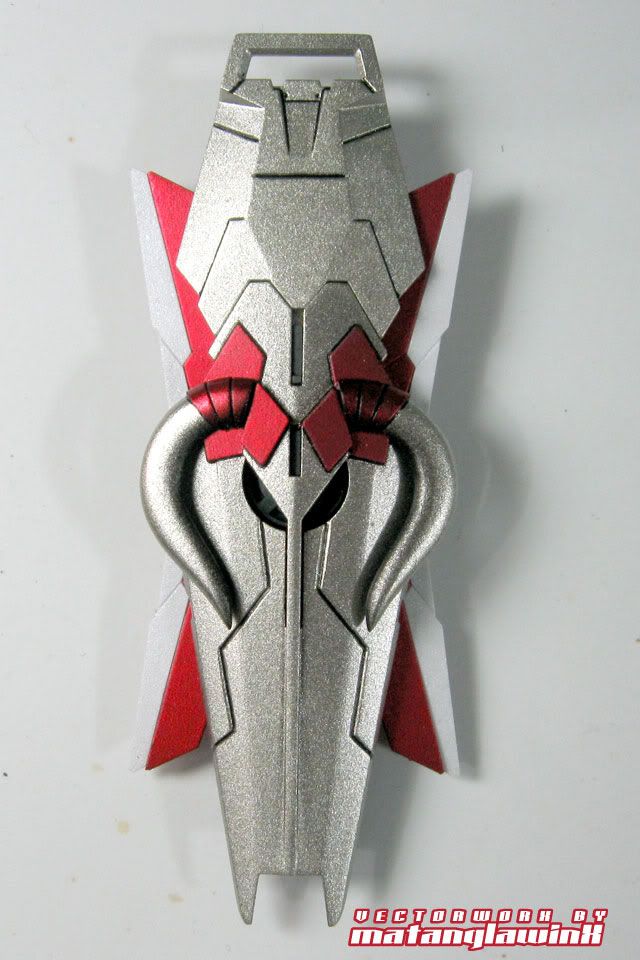
My first attempt with the MatX Multitone/Color Change/Gradient, which back then, no one really attempted with cans. This is achieved with Flat Black, then Gold 351 and Honda Red 67 sprayed at opposite angles to create the gradient effect |
I've stopped using Bosny Metallic Red (along with Metallic Blue and Metallic Black) back then because even with dry conditions and considerable spray distance it still tends to be too thick. The Bosny Metallics are also opaque, so it was pretty useless having laid down a layer of gold before it, which also contributed to thickness.
So far, I've found that Bosny Gold, Silver, Aluminum, Aluminum Silver and Metallic Silver are good buffer paints for clear and candy tones. With misting, they can cover a part without obscuring the details. The photos above and below show my first attempts with the buffer/candy tone technique, and discovered quite by accident that spraying at opposite angles could create a somewhat color change depending on the angle to which the light hits the painted part, which is actually more of a gradient.


Though I've seen gradients done quite easily done with AB, I haven't seen anyone else do this with cans on small parts back then.
The Myth Behind the Mist
There is no singular technique in achieving a great paint job with cans, but, the best technique so far, at least for me, is misting. The main issue people have with it is paint wastage; misting does require one to spray at a more significant distance, and the farther you spray, the larger the spray diameter. So people will always tend to spray closer to economize on paint, without realizing that that method is actually more unpredictable, especially since cans do lose pressure as the paint is expended. The result; overspray and uneven coats.
Misting allows one to gauge where and how the paint lands on a certain surface, and not all surfaces get painted the same way. People also make the mistake of keeping the can stationary while depressing the nozzle. Both the part and can must be moving constantly in opposite directions, with curved parts rotated as the paint is misted to give it more coverage. Misting keeps the paint particles small, and as I have mentioned early, dry quickly as it lands on the surface.


With misting, I've been able to avoid overspray and achieve a paint layer close to that of an AB (of course, I wouldn't want to argue with any AB user that it's the same, hence "close"). The above shows several coats of Flat Black, Nickel Chrome and Honda Red 67 (which takes a LOT of passes to achieve a full coat), and as you can see, the surface details remain clear even after the Flat Clear (which creates the muted metallic/red titanium effect).
Compare that to a relatively <simpler> Titanium White (Flat White, Pearl White, Flat Clear)


So far, the only drawback with Bosny paints is that it has a very "limited" range of colors. I don't follow recommended color schemes anyway, more so, I often use my favorite color, RED and variants of it, so, that has never been an issue to me. But recently, I've been experimenting on combining flat and candytones to create new colors.
Bosny recently introduced the White Pearl, a semi-clear pearlescent white "top coat," along with Flat Clear, which is what I've used to create the titanium-white effect with the Stein. Using pearl white over ANY color gives it a dulled-down pearl/glittery effect.
 |
| Bottom: Standard metallic buffer>clear red>flat clear combo. Top: with Bosny White Pearl |
White Pearl creates a lighter, almost pinkish red tone, somewhat like an "old rose" feel to it. This expands the color scheme a bit, as such, I can use it for any "Char" mobile suit variation, instead of the "salmon pink" which actually more orange. Adjusting the densities of the buffer, candy tone and White Pearl creates subtle color variances which I can use to enhance gradient effects.
There's also Black Tint, a "clear black" top coat, which is equivalent to Tamiya's "Smoke."
 |
| Left: Bosny Gold 351 Right: with Bosny Black Tint |
 |
| Left: Standard Candytone Red Right: with Bosny BlackTint |
Black Tint gives regular colors a darker shade, with the added effect of being almost black in some sections depending on the angle of light as the part curves.
It's also worthwhile to note that Don Suratos aka DC23, won his first BAKUC World Championship with a split-color Kampfer painted with Bosny. He was actually the one who inspired me to paint with cans.